
Blog Articles
Seven in Ten Employers Exclude Candidates – Or Do They?
Mar 19, 2026
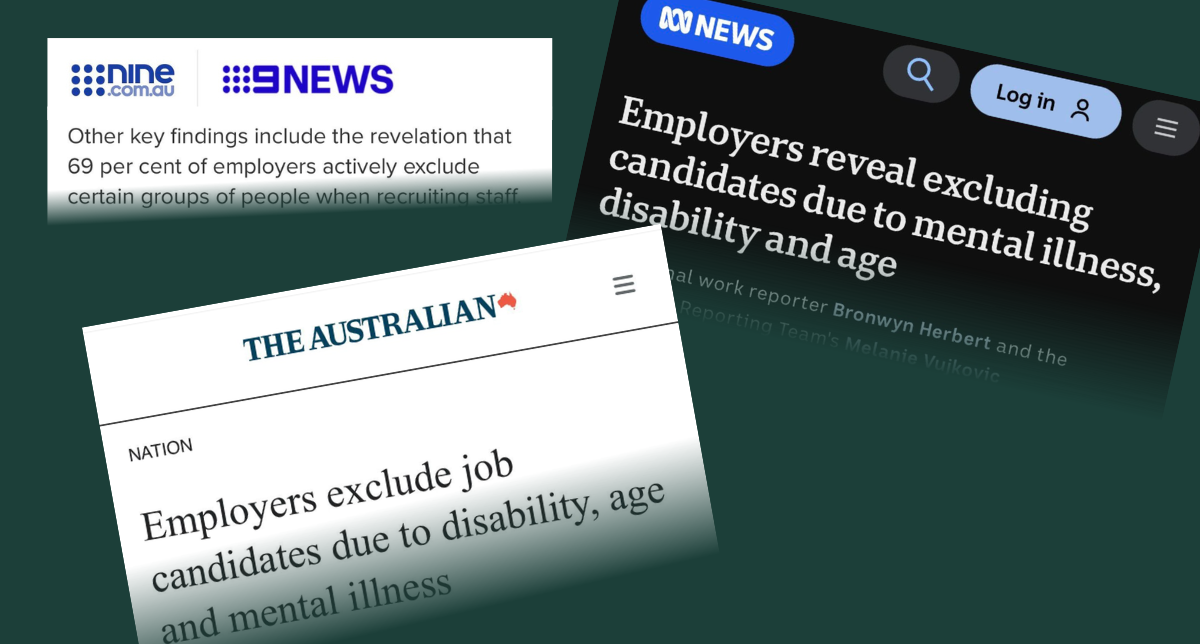
This week, multiple media outlets reported findings from the Australian Human Resources Institute Work Outlook survey, claiming that 69% of employers reportedly exclude candidates with certain characteristics during recruitment.
At first glance, the reporting suggests that systemic discrimination is increasing in Australian recruitment. However, the underlying report does not include the full survey question, so any analysis must rely on the statistics presented in media coverage.
Based on the available information, including the March 2025 report, the 2026 survey appears to have asked ask:
“Does your organisation deliberately exclude candidates with any of the following characteristics?”
In reality, this question captures whether organisations apply any screening criteria during recruitment, rather than whether they engage in discriminatory behaviour.
Many exclusions in hiring reflect legal or regulatory requirements, not bias. Roles often require criminal background checks or drug and alcohol screening – identified as the two most selected categories – particularly in safety-critical industries. Interpreting such screening as evidence of unethical or unlawful behaviour is not a well-founded conclusion.
A further limitation of the data is that it combines several fundamentally different types of hiring criteria into a single headline statistic:
· Compliance-related factors For example, criminal history, and drug or alcohol screening
· Practical hiring considerations For example, employment background and experience
· Protected characteristics For example, disability, mental illness or age
The reported figure – 69% of employers – indicated that an organisation selected at least one item from the list. Therefore, it may reflect routine practices such as conducting criminal background checks or requiring workers to be drug-free in safety-critical roles. By aggregating these categories, the data draws no clear distinction between compliance-based screening and potential discrimination.
The 69% figure only indicates that an employer selected at least one category.
In labour market research, these factors are typically measured separately, allowing analysts to distinguish between compliance requirements, job-related screening and potential discrimination.
More broadly, this highlights a recurring issue in organisational data: treating a single headline figure as a reliable guide to what is actually happening operationally.
Understanding how decisions are made within organisations requires more than top-line figures. It requires examining the decision architecture behind behaviour: the incentives, compliance requirements and judgement calls that influence outcomes.
Ambiguous indicators can drive misleading narratives. A more effective approach is to design measures that accurately capture how governance frameworks, incentives and risk structures shape real decisions.
Without that clarity, organisations risk measuring the narrative they want to tell, rather than the reality of how decisions are made. Media framing is then shaped by how a survey question is designed, rather than how organisations actually behave.
Organisations often end up measuring the narrative they want to tell, rather than reality. Headlines are shaped by question design – not by organisational behaviour.
For leaders making decisions based on data, that distinction matters.
At MIC Advisors, we partner with leaders who understand the importance of measuring what matters – how metrics, incentives and governance structures influence the decisions that drive results.
Good leadership depends not just on measuring outcomes, but on understanding what your metrics truly measure.